
Unit Conversion Practice Problems with Answers (Physics) ⎼ Article Plan
This plan details a comprehensive resource, including a downloadable PDF worksheet, focused on physics unit conversion. It will cover various problems,
with detailed solutions, aiding CBSE Class 11 students and beyond.
Unit conversion is a cornerstone of physics, enabling us to relate different ways of measuring the same physical quantity. It’s the process of changing a value from one unit to another, maintaining the original magnitude. This isn’t merely a mathematical exercise; it’s fundamental to ensuring consistency and accuracy in scientific calculations and real-world applications.
Imagine trying to compare a distance measured in miles with one measured in kilometers without converting them to a common unit! This highlights why mastering unit conversion is so crucial. Resources like PDF worksheets containing physics practice problems are invaluable tools for solidifying this skill. These worksheets, often aligned with curricula like CBSE Class 11, provide targeted practice.
Successfully navigating unit conversion requires understanding conversion factors and applying them strategically. A strong foundation in this area unlocks the ability to solve complex physics problems and interpret experimental data effectively. The ability to perform these conversions is essential for success in all areas of physics.
Why Unit Conversion is Crucial in Physics
Unit conversion isn’t simply about changing numbers; it’s about ensuring the validity and comparability of physical measurements. Physics relies on universal laws, and these laws must hold true regardless of the units used. Without consistent units, calculations become meaningless, and predictions unreliable.

Consider a scenario involving velocity – expressing it in meters per second versus miles per hour drastically alters numerical values. Accurate physics problem-solving demands converting to a standardized system, often the International System of Units (SI). Practice problems, readily available in PDF format, are vital for developing this proficiency.
Furthermore, many real-world applications, from engineering to astronomy, require seamless transitions between different unit systems. Resources designed for curricula like CBSE Class 11 emphasize this practical necessity. Mastering unit conversion prevents errors and fosters a deeper understanding of physical principles, ultimately leading to more accurate and meaningful results.
Fundamental Units & Systems (SI & Imperial)
Physics employs various measurement systems, but two dominate: the International System of Units (SI) and the Imperial system. SI, the modern standard, offers a coherent and decimal-based structure, simplifying unit conversion. Fundamental SI units include meters (length), kilograms (mass), and seconds (time). Understanding these base units is crucial for tackling complex problems.
Conversely, the Imperial system, prevalent in the United States, utilizes units like feet, pounds, and seconds. Converting between SI and Imperial requires specific conversion factors, often found in readily available PDF resources designed for practice. CBSE Class 11 students often encounter both systems, necessitating fluency in their interconversion.
The ability to navigate these systems isn’t merely mathematical; it’s conceptual. Recognizing the relationships between units – for example, knowing that 1 meter equals approximately 3.28 feet – is key to successful problem-solving and avoiding common errors. Consistent practice with unit conversion practice problems solidifies this understanding;
Common Physics Units & Their Symbols
Physics relies on a standardized set of units, each represented by a specific symbol. Mastering these is fundamental for solving unit conversion practice problems. For length, we use meters (m), kilometers (km), and feet (ft). Mass is measured in kilograms (kg) and pounds (lb), while time is expressed in seconds (s), minutes (min), and hours (h).
Beyond these basics, velocity employs meters per second (m/s), acceleration uses m/s², and force is measured in Newtons (N). Energy is commonly expressed in Joules (J), power in Watts (W), and work also in Joules (J). A comprehensive PDF resource will list these alongside their conversion factors.
Familiarity with these symbols isn’t just about memorization; it’s about efficient problem-solving. CBSE Class 11 curricula emphasize recognizing and correctly applying these units. Accurate symbol usage prevents errors and ensures clarity when working through calculations and physics exercises.
Length, Mass, and Time Units
Length conversions frequently involve meters (m), centimeters (cm), kilometers (km), feet (ft), and inches (in). A physics unit conversion practice problems PDF will include exercises like converting 5 meters to centimeters or 10 feet to meters. Mass is typically measured in kilograms (kg) and grams (g) within the metric system, and pounds (lb) and ounces (oz) in imperial units.
Time conversions are crucial, moving between seconds (s), minutes (min), hours (h), and days. Problems might ask for the equivalent of 2 hours in seconds. These fundamental units form the basis for more complex physics calculations.
Understanding the relationships between these units – like 1 meter equaling 100 centimeters – is key. CBSE Class 11 students benefit from dedicated practice. A well-structured PDF resource provides ample opportunities to solidify these foundational skills, ensuring accuracy in subsequent physics topics.
Velocity, Acceleration, and Force Units
Velocity, measuring displacement over time, commonly uses meters per second (m/s) and kilometers per hour (km/h). A physics unit conversion practice problems PDF will present scenarios like converting 60 km/h to m/s. Acceleration, the rate of change of velocity, is measured in meters per second squared (m/s²). Practice involves changing between different units of speed and time.
Force, defined by Newton’s second law (F=ma), is measured in Newtons (N). Since 1 N = 1 kg⋅m/s², conversions often involve mass and acceleration units. A PDF resource will include problems requiring students to calculate force given mass in grams and acceleration in cm/s².
Mastering these conversions is vital for CBSE Class 11 physics. Consistent practice, facilitated by a comprehensive PDF, builds confidence and accuracy in solving dynamic problems, ensuring a strong grasp of fundamental concepts.
Energy, Power, and Work Units
Energy, the capacity to do work, is measured in Joules (J). A physics unit conversion practice problems PDF will feature conversions between Joules, kilojoules (kJ), and even calories (cal) or British thermal units (BTU). Work, done when a force causes displacement, also uses Joules (J). Problems might involve calculating work done given force in Newtons and distance in centimeters.
Power, the rate at which work is done, is measured in Watts (W). Since 1 W = 1 J/s, conversions frequently involve time units. A PDF resource will present scenarios converting horsepower (hp) to Watts, crucial for understanding mechanical systems.

For CBSE Class 11 students, a well-structured PDF with detailed solutions is invaluable. Consistent practice solidifies understanding of these interconnected concepts, enabling accurate problem-solving and a deeper appreciation of energy principles.
One-Step Unit Conversions: A Foundation
One-step unit conversions are the bedrock of mastering physics calculations. These involve directly multiplying a value by a conversion factor to change its unit. A unit conversion practice problems PDF should begin with these fundamentals, building confidence before tackling complexity.
Examples include converting meters to centimeters (using the factor 1 m = 100 cm), or kilograms to grams (1 kg = 1000 g). These seemingly simple conversions are essential for setting up more intricate multi-step problems. A good physics resource, like a CBSE Class 11 focused PDF, will emphasize identifying the correct conversion factor.
Practice is key; a PDF worksheet should offer numerous problems, with clearly presented answers, to reinforce this foundational skill. Mastering these initial steps streamlines future calculations and minimizes errors.

Multi-Step Unit Conversions: Tackling Complexity
Multi-step unit conversions build upon the foundation of one-step conversions, requiring a strategic application of multiple conversion factors. A comprehensive unit conversion practice problems PDF for physics must dedicate significant space to these scenarios.
For instance, converting kilometers per hour (km/h) to meters per second (m/s) necessitates converting both kilometers to meters and hours to seconds. This involves a chain of multiplications, ensuring units cancel appropriately. The CBSE Class 11 curriculum often features such problems.
A well-structured PDF worksheet will present these problems with increasing difficulty, guiding students through the process; Detailed solutions are crucial, demonstrating each step and explaining the reasoning behind each conversion factor used. Mastering this skill is vital for advanced physics concepts.
Dimensional Analysis: A Powerful Tool
Dimensional analysis is an invaluable technique in physics, extending beyond simple unit conversion. It’s a method for checking the relationships between physical quantities by identifying their dimensions – length (L), mass (M), time (T), etc. A robust unit conversion practice problems PDF should incorporate dimensional analysis checks.
By ensuring that the dimensions on both sides of an equation match, you can verify its correctness, even before plugging in numerical values. This is particularly useful when dealing with complex formulas. For CBSE Class 11 students, understanding dimensional analysis builds a strong conceptual foundation.
A good physics worksheet will include problems where students must determine the dimensions of a quantity or identify errors in an equation based on dimensional inconsistencies. This reinforces the importance of units and their role in physical laws, enhancing problem-solving skills.
Conversion Factors: Identifying and Applying Them
Conversion factors are the cornerstone of successful unit conversion in physics. These ratios, equal to one, express the equivalence between different units – for example, 1 meter = 100 centimeters, providing the factor 100 cm/1 m. A comprehensive unit conversion practice problems PDF must emphasize identifying appropriate factors.
The ability to strategically apply these factors is crucial. Problems often require multiple conversions, demanding a systematic approach. Students need to understand how to arrange conversion factors to cancel unwanted units and arrive at the desired units. This skill is vital for CBSE Class 11 students and beyond.
Effective practice materials will present scenarios requiring students to select and apply the correct conversion factors, reinforcing their understanding. A well-structured physics worksheet will include both direct and indirect conversion problems, building confidence and proficiency.
Practice Problems: Length & Distance Conversions
Length and distance conversions form a foundational element of physics problem-solving. A robust unit conversion practice problems PDF should include a variety of exercises, starting with simple conversions between meters and centimeters, then progressing to kilometers, miles, and feet.

Problems should incorporate real-world scenarios, such as calculating distances traveled, determining the dimensions of objects, and interpreting measurements from different scales. Students will benefit from practice converting between SI and Imperial units, reinforcing their understanding of both systems.
The PDF should provide detailed solutions, demonstrating the step-by-step application of conversion factors. Including problems relevant to CBSE Class 11 curriculum standards will enhance its educational value. Mastering these conversions is essential for tackling more complex physics concepts.
Practice Problems: Mass & Weight Conversions
Mass and weight conversions are crucial in physics, often causing confusion between the two concepts. A comprehensive unit conversion practice problems PDF must address this distinction, providing exercises focused on converting between grams, kilograms, pounds, and ounces.
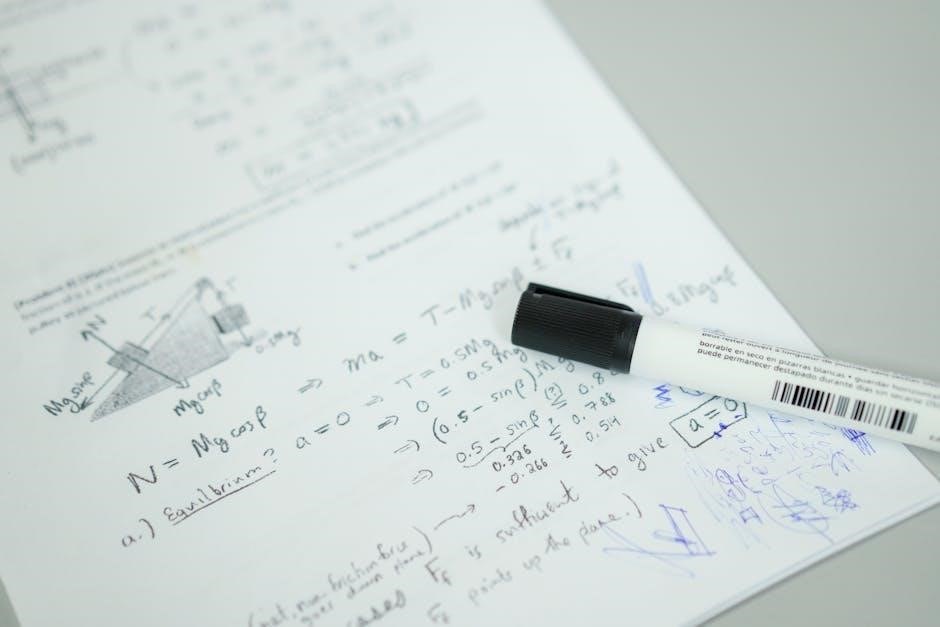
Problems should involve scenarios like calculating the mass of an object given its weight on Earth or another planet, and converting between different units for laboratory measurements. The PDF should emphasize the difference between mass (a measure of inertia) and weight (the force of gravity on a mass).
Detailed solutions should clearly demonstrate the use of appropriate conversion factors and explain the underlying principles. Exercises aligned with CBSE Class 11 standards will be particularly valuable. This practice builds a strong foundation for understanding physics principles related to force and motion.

Practice Problems: Time Conversions
Time conversion practice is fundamental in physics, as many equations rely on consistent time units. A dedicated section within the unit conversion practice problems PDF should offer a range of exercises converting between seconds, minutes, hours, days, and years. Problems should include scenarios involving calculating elapsed time, converting rates (like speed) with different time units, and understanding astronomical time scales.

The PDF should include problems requiring multi-step conversions, such as converting milliseconds to hours. Detailed solutions must clearly illustrate the process, emphasizing the importance of dimensional analysis. Exercises should cater to various difficulty levels, suitable for students revising CBSE Class 11 material.
Accuracy in time conversions is vital for precise calculations in mechanics and other physics branches, making this a critical skill to master.
Practice Problems: Velocity & Speed Conversions
Velocity and speed conversions are crucial in physics, demanding proficiency in unit manipulation. The unit conversion practice problems PDF must dedicate a section to these, covering conversions between meters per second (m/s), kilometers per hour (km/h), miles per hour (mph), and feet per second (ft/s). Problems should incorporate both velocity (vector) and speed (scalar) scenarios.
Exercises should include calculating average speed, instantaneous velocity, and resolving velocity components. Multi-step conversions, like converting km/h to m/s, are essential. The PDF should provide step-by-step solutions, reinforcing the use of conversion factors and dimensional analysis – skills vital for CBSE Class 11 students.
Real-world applications, such as vehicle speeds and projectile motion, should be included to demonstrate practical relevance.
Practice Problems: Acceleration Conversions

Acceleration conversions, a core component of physics problem-solving, require a dedicated section within the unit conversion practice problems PDF. Focus should be on converting between meters per second squared (m/s²), kilometers per hour squared (km/h²), and feet per second squared (ft/s²). Problems must assess understanding of acceleration as a rate of change of velocity.
The PDF should include scenarios involving uniform and non-uniform acceleration, requiring students to apply conversion factors correctly. Multi-step conversions, alongside problems involving gravitational acceleration (9.8 m/s²), are vital. Detailed, step-by-step solutions are crucial for CBSE Class 11 students, emphasizing dimensional analysis.
Include problems relating acceleration to force (Newton’s Second Law) to demonstrate interconnectedness of concepts.
Practice Problems: Force Conversions
Force conversion practice, essential for a robust physics understanding, demands a dedicated section within the unit conversion practice problems PDF. The primary focus will be converting between Newtons (N), dynes, and pounds-force (lbf). Problems should incorporate Newton’s Second Law (F=ma) to link force, mass, and acceleration, requiring conversions within the equation.
The PDF should present scenarios involving various forces – gravity, friction, applied force – demanding students apply appropriate conversion factors. Multi-step conversions, including those involving weight (mg), are crucial. Detailed solutions, geared towards CBSE Class 11 students, must emphasize dimensional analysis and proper unit handling.
Include problems requiring conversion of force components (e.g., resolving forces into x and y components) to enhance problem-solving skills.
Practice Problems: Energy Conversions
Energy conversion problems form a vital component of the unit conversion practice problems PDF for physics students. This section will concentrate on converting between Joules (J), calories (cal), British thermal units (BTU), and kilowatt-hours (kWh). Problems should integrate common energy formulas – kinetic energy (KE = 1/2mv2), potential energy (PE = mgh) – requiring conversions of mass, velocity, height, and gravitational acceleration.
The PDF will feature scenarios involving work done, heat transfer, and power, demanding students apply appropriate conversion factors. Multi-step conversions, particularly those relating to electrical energy, are essential. Detailed solutions, suitable for CBSE Class 11, will highlight dimensional analysis and careful unit management.
Include problems requiring conversions within energy density calculations to solidify understanding.

Common Mistakes to Avoid in Unit Conversion
When tackling unit conversion practice problems – especially when utilizing a physics PDF worksheet – several errors frequently occur. A primary mistake is forgetting to square or cube units when dealing with area or volume conversions. Incorrectly applying conversion factors, or using outdated values, also leads to inaccuracies.
Students often fail to account for significant figures, impacting the precision of their answers. Dimensional analysis, while powerful, can be misused if units aren’t canceled correctly. A common oversight is neglecting to convert all values to consistent units before performing calculations.
The PDF will emphasize these pitfalls, providing worked examples demonstrating correct procedures. For CBSE Class 11 students, recognizing these errors is as crucial as mastering the conversions themselves, fostering a robust understanding.
Resources for Further Practice (PDF Worksheets)
To solidify understanding of unit conversion practice problems in physics, a curated collection of PDF worksheets will be provided. These resources cater to varying difficulty levels, starting with one-step conversions and progressing to multi-step challenges, ideal for CBSE Class 11 students.
Worksheets will include detailed answer keys, allowing for self-assessment and immediate feedback. Supplemental materials will focus on common unit systems (SI and Imperial) and emphasize dimensional analysis techniques. The PDF format ensures accessibility across devices, facilitating convenient practice.
Additional online resources, linking to interactive quizzes and problem generators, will also be listed. These materials aim to provide a comprehensive learning experience, moving beyond rote memorization to foster genuine problem-solving skills.
Proficiency in unit conversion is paramount for success in physics, forming the bedrock for accurate calculations and conceptual understanding. Consistent practice, utilizing resources like the PDF worksheets provided, is key to building this crucial skill. Remember, a strong grasp of fundamental units and conversion factors is essential.
Don’t underestimate the power of dimensional analysis – it’s a powerful tool for verifying calculations and preventing errors. Regularly reviewing unit conversion practice problems, and analyzing mistakes, will reinforce learning. Resources for CBSE Class 11 and beyond are readily available.
Ultimately, mastering these skills unlocks a deeper comprehension of physical principles and prepares you for more advanced studies. Embrace the challenge, practice diligently, and unlock your full potential in physics!